Wednesday, August 15, 2012

Gender Quotes x2

Looking through some discarded viewing notes I came across these two quotes jotted down on the same paper.

"Well I hear movie actors are getting five, ten thousand a week. For what? For acting tough. For pushing girls in the face. What do they do I can't do?" -Johnny, Scarlet Street
"The death of a beautiful girl is the most poetical topic in the world." -Edgar Allen Poe, Twixt

Two sides of the same coin.

Friday, August 10, 2012

Wuthering Heights + how to watch a movie #3

wutheringheights

(Andrea Arnold / 2011)

Arnold's approach to the material emphasizes the immediacy of every moment, which works to complicate overly simplistic ideas of systems of oppression. Here she creates a world were the abstract matrices of classification (class, race, gender) are always in operation, determining who can go where, and what space belongs to whom, but without dehumanizing her subjects into lifeless statistics or well-meaning liberal charity cases. Instead she problematizes notions of social progress without claiming that nothing ever changes: this period piece does not play like a foreshadowing historical prologue like The White Ribbon. Her relation to space often undermines concrete notions of privilege and power, as spaces are constantly invaded and destabilized. Much like Fish Tank (I've yet to see Red Road) her style presents the reckless self-destructive actions of certain individuals as partly the result of a denial of agency, as a rejection of class systems, and not (according to prevalent conservative theories) as the result of the inherit natures of certain people, but as almost inevitable reactions to certain realities.

Wuthering Heights is a sensual complication of the sensual; it problematizes a perceived metaphysical relationship to existence, which never denies an analytical assessment of social structure (unlike, say, The Tree of Life which privileges uncritical nostalgia over reflection). But my intention is not to value this masterpiece in opposition to other films, Wuthering Heights has multiple strengths worthy of further analysis, I've merely drawn out a few themes of particular interest to me.

***

It's always frustrating to find a great work that goes undistributed, but something about the total erasure of Wuthering Heights is striking. Arnold, by my count, is among the most interesting young filmmakers at work today, yet this film is totally absent from current American film culture, save for a few scattered festivals. In Chicago it played for a single showing during the European Union Film Festival, while most entries screened at least twice. A wider release was announced by Oscilloscope earlier this year prior to Adam Yauch's death, but nothing has been mentioned since and no information is available on their site.

Although I'd rather not watch this on my tiny laptop screen, sometimes we are not given options. And while it may eventually get North American distribution, my impatience led me to pirate the film. A high quality digital version was already available for quite some time, as the film has made it to DVD in the United Kingdom from Artificial Eye.

While too many films by many types of filmmakers fall in the cracks made by the business of film distribution, it does seem that many art house works directed by women (even successful ones) get stalled so long that the essential buzz evaporates. This was also the case with We Need to Talk About Kevin (also picked up by Oscilloscope). I've noticed a trend, or say a theory of mine, that films that fall into these holes are often denied the end of year discussion or list making, since so many critics, bloggers, and forum users are particular about a films date of debut. While Wuthering Heights first screened in 2011, for most people it was never even an option until 2012 (and still unavailable to most so late in the year). I am by no means saying a conspiracy exists that plots to marginalize women filmmakers by fucking up their criteria for entry into best of lists, only that this confusion/erasure seems to happen quite often, which is magnified when the few who have seen it reject it outright (as in most responses to Kevin).

Most of the 'buzz' surrounding Wuthering Heights is in regards to Heathcliff's "race lift" and it is regrettable that this has monopolized the conversation. A few bloggers that I admire have written in praise of this film, which added to the urgency to see it. I can't recommend it enough, either purchase or pirate this DVD.

Wednesday, August 1, 2012

Chris Marker, 1921-2012

chat3

"As a result of saying it can show anything, cinema has abandoned the power over the imagination. And, like cinema, this century is perhaps starting to pay a high price for this betrayal of the imagination - or, more precisely, those who still have an imagination, albeit a poor one, are being made to pay that price."
***

When I heard of Chris Marker's death I wandered back into that magnificent mess of his, where The Legend of Bruce Lee occupies cherished shelf space:


From Agnès Varda's Agnès de ci de là Varda, Episode 1, 2011.

I'm curious to note what Marker's thoughts were on the Obama presidency. Did he, like most cautiously supportive radical leftists, recoil in horror? Here we are only given pre-election imagery.

***

Then I watched Vertigo.

http://pantherpro-webdesign.com/cinema/cinema/add/Hitchcock-vertigo200X113.gif

from Marker's A Free Replay (notes on Vertigo):

"Obviously, this text is addressed to those who know Vertigo by heart. But do those who don't deserve anything at all?" [search this passage and you'll fine the entire pdf]

"In this case, the entire second part would be nothing but a fantasy, revealing at last the double of the double. We were tricked into believing that the first part was the truth, then told it was a lie born of a perverse mind, that the second part contained the truth. But what if the first part really were the truth and the second the product of a sick mind"

which reminds me...

 "What Scottie first experiences in Vertigo is the loss of Madeleine, his fatal love; when he recreates Madeleine in Judy and then discovers that the Madeleine he knew actually was Judy pretending to be Madeleine, what he discovers is not simply that Judy was faking (he knew that she was not the true Madeleine, since he had recreated a copy of Madeleine out of her), but that, because she was not faking - she is Madeleine, Madeleine herself was already a fake - the objet a disintegrates, the very loss is lost, and we see a 'negation of negation'. His discovery changes the past, deprives the lost object of the objet a."
-Slavoj Žižek, Everything You Always Wanted to Know About Lacan But Were Afraid to Ask Hitchcock

Marker deserves the last word here:

"Scottie experiences the greatest joy a man can imagine, a second life, in exchange for the greatest tragedy, a second death. What do video games, which tell us more about our unconscious than the works of Lacan, offer us? Neither money nor glory, but a new game. The possibility of playing again. 'A second chance.' A free replay."

***


***

6 August. Encounters. Chris Marker is in town. He goes back to where he's been and films "randomly", rather happy to have emerged from the adventure of A Grin Without a Cat. His friend Terayama shoots in HK. The festival staff organises a lunch. Marker tells me that HK (which he doesn't like) has changed a lot. He comes from Okinawa and is on his way to China where he hasn't been since Sundays in Beijing. During the meal (on a very hot day), we talk about several things: Bruce Lee's mysterious death, the rumour that the Red Army guards may have filmed things during the cultural revolution. What happened to these films? Will we see them one day? What do they do with films over there? Do they archive them? Someone shows me the press clip of a Chinese newspaper talking about the fire at the warehouse of the Cinémathèque française. And also, why preserve / curate? Cinema will perhaps have been the collective dream of the 20th century? Marker is going to take pictures in Cat Street. We leave each other. - Serge Daney, Cahiers du Cinéma 1981 (X)

***

 Level 5                                              La jetée                                          Le mystère Koumiko

                A Cat Listening to Music                   AK                  San Soleil


...many thanks to Catherine Grant at Film Studies for Free (X).

***
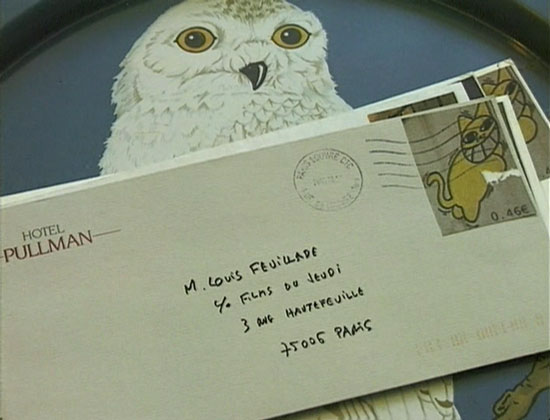
"With all due reverence, I—to be honest—sometimes wonder whether there is not something coy and self-indulgent in the private mythology Marker has been spinning over the years: his grinning cats, his owls, Guillaume-en-Egypte, his female assistants . . . And the somewhat loose hermetic nature of his pronouncements frustrate the essayist in me, who would prefer that he grapple with what he seems to mean and wrest as much clear understanding as can be had. It strikes me as peculiar that our greatest essay-filmmaker should traffic so willingly in the enigmatic, the borderline-sentimental, and the faux-naïve."

"What also disturbs me is that those who have personal access to the Master, through e-mail correspondence and personal visits, have set up such a fond protection wall around him against critical judgment, accepting everything that emanates from him as a kind of indivisible pre-posthumous miracle, that it inhibits the making of distinctions about his stronger and weaker expressions. On the other hand, maybe I should just calm down and accept whatever is given me from Marker’s reshuffling of archives in the proper spirit of gratitude." (X)

These selections from Phillip Lopate were plucked for scrutiny by Adrian Martin in Chris Marker: Notes in the Margins of His Time for Cineaste Vol. XXXIII No. 4 (Fall 2008).

***

from that same issue comes this curio, the lone footnote in Marker's piece The Last Bolshevik: Reminiscences of Alexander Ivanovich:

"Just before he died in 1988, Jay Leyda was working on a monumental Medvedkin anthology, including his diary of the train [the Kinopoezd], scripts from the movies, and lots of critical pieces. Then he passed away, and I never heard anything further about the project, as if it never existed. A true mystery. If anyone has any information about this, or knows the whereabouts of Leyda's Medvedkin materials, please contact me c/o Cineaste."

***


***
"Godard nailed it once and for all: at the cinema, you raise your eyes to the screen; in front of the television, you lower them. Then there is the role of the shutter. Out of the two hours you spend in a movie theater, you spend one in the dark. It's this nocturnal portion that stays with us, that "fixes" our memory of a film (the way you fix color on a canvas) in a different way than the same film seen on television or on a monitor. But having said that, let's be honest. I've just watched the ballet from An American in Paris on the screen of my iBook, and I very nearly rediscovered the exhilaration that we felt in London, in 1952, when I was there with Alain Resnais and Ghislain Cloquet, during the filming of Statues Also Die, when we would start every day by seeing the 10:00 a.m. show of An American in Paris at a theater in Leicester Square. An exhilaration that I feared I had lost forever when watching the film on cassette."

"I have a completely schizophrenic relationship with television. When I assume I'm the only one in the world, I adore it, particularly since there's been cable. It's curious how cable offers an entire catalog of antidotes to the poisons of standard TV [...] Now there are moments when I remember I am not alone in the world, and that's when I fall apart. The exponential growth of stupidity and vulgarity is something that everyone has noticed, but it's not just a vague sense of disgust--it's a concrete, quantifiable fact (you can measure it by the volume of the cheers that greet the talk-show hosts, which have grown by an alarming number of decibels in the last five years) that comes close to a crime against humanity [...] I must say the worst: I am allergic to commercials. In the early sixties, that allergy was rather well considered. Today it's unavowable." (X)

from an interview by Samuel Douhaire and Annick Rivoire for  Libération, translated by Marker for publication in the Criterion release of La jetée + Sans Soleil.
***

"To be able to play the games of culture with the playful seriousness which Plato demanded, a seriousness without the 'spirit of seriousness', one has to belong to the ranks of those who have been able, not necessarily to make their whole existence a sort of children's game, as artists do, but at least to maintain for a long time, sometimes a whole lifetime, a child's relation to the world. (All children start life as baby bourgeois, in a relation of magical power over others and, through them, over the world, but they grow out of it sooner or later.) This is clearly seen when, by an accident of social genetics, into the well-policed world of intellectual games there comes one of those people (one thinks of Rousseau or Chernyshevsky) who bring inappropriate stakes and interests into the games of culture; who get so involved in the game that they abandon the margin of neutralizing distance that the illusio (belief in the game) demands; who treat intellectual struggles, the object of so many pathetic manifestos, as a simple question of right and wrong, life and death. This is why the logic of the game has already assigned them roles--eccentric or boor--which they will play despite  themselves in the eyes of those who know how to stay within the bounds of the intellectual illusion and who cannot see them any other way."
-Pierre Bourdieu, Distinction: A Social Critique of the Judgement of Taste


***

a personal note

My first encounter with Chris Marker was entirely by chance - in fact I hadn't even known I had encountered him. It was my first viewing of Alain Resnais' Night and Fog, screened, not for a film class, but for one on the Holocaust, where I first witnessed the power of the visual essay. Marker's contributions go uncredited, a secret collaborator that is absent even from the liner notes of the Criterion DVD.

It seems strangely fitting that my last encounter with him during his own lifetime was a return to the concentration camps*, where in interview he concludes by discussing two artists destined for greatness who died in the camps: François Vernet and Viktor Ullmann. Ullmann is as good as any place to stop.


*Oddly enough, on the date of Marker's birth, July 20th, 1921, Adolf Hitler was publicly introduced as party chairman of the National Socialist German Worker's Party (according to some sources, others say it was the the 28th or 29th). This is perhaps the first time I've regretted putting my Shirer texts in storage.

Saturday, July 28, 2012

The Dark Knight Rises


This is a review I sent to an online publication for consideration. I have yet to hear back and they have since posted what I believe to be their Piece on the subject, so I feel there is no harm in posting this (if, by chance, they post it, then I will take this down). The style is a bit different from what I post here as I attempted to conform to their house style.

This was written hours after a midnight screening and thus represents my immediate reactions. Upon further contemplation I realize I say much of the same things as other dissenters, such as the point that Ann Hathaway was almost a saving grace (although most complain she wasn't 'sexy enough'), the comparison to the crassness of Michael Bay, and that at least The Dark Knight had Heath Ledger.

It does not carefully consider the politics of the film (again: house style), which may be cause for another post down the line.

***

Photobucket


(Christopher Nolan / 2012)

In the latest Bat-film, The Dark Knight Rises, Christopher Nolan concentrates his love affair with 80s urban thrillers: the helicopter skylines, the poverty-porn formalism, the smothering ominous tones, and the schizoid nightmare fantasies of xenophobic militiamen. It’s a tad presumptuous to claim that Nolan is actively fooling his audience with his pseudo Dick Wolf naturalism, but his brutalist architectural approach to drama feeds a ready-made audience apparently starving for self-aggrandizing seriousness—for Grown-Up versions of boyhood favorites; in video game terms, what amounts to the Mortal Kombat-ification of American pop culture*.

Whereas The Dark Knight had a handful of worthwhile features—the weakest performance of Ledger’s career and a superbly executed opener (although it should’ve been aped shamelessly from Zulawski’s L’amour braque)—Rises has none of the isolated pleasures that floundered in the previous films. While it’s only ten more minutes than Dark Knight, it manages to feel hours longer, exacerbated by the high dosage of pomposity that transforms the excitement of silent serial tropes and Lewis Carroll allusions into tasteless political sludge.

Ann Hathaway offers a fleeting moment of respite, disregarding her desperate performance and throwaway character, by reminding us that the lineage of the Bat-films is worthy of excavation, echoing Fulliade, Lang, Franju, and Melville—even Tim Burton—who understood that their worlds were phantasms and fabrications. Nolan’s Bat-verse, which is as plastic as Burton’s, suffers from its inability to acknowledge this humble fact. The insular set pieces of Batman’s ancestors implied vast, expansive universes, a talent that Nolan desperately lacks: his cities are devoid of culture—everything is a neo-classical bank or an anonymous corporate building, populated by grimacing white people and newspaper tumbleweeds.

The Dark Knight Rises is high Kitsch and damn near hilariously so. What makes Nolan a standout is his longer than average shot length, which to the imdb-generation means he’s patient, ergo more mature. He’s also better at conjuring a dense topical fog than say, Michael Bay.  His procedural formality has become the bedrock of the contemporary prestige piece, but whereas a director like David Fincher interrogates the anxiety of mystery and blows open the cracks in tightly knit yarns, Nolan’s modus operandi is to make every detail, every word, every cutaway refer to an eventual deus ex machina, effectively obliterating all sense of wonder that makes classic thrillers soar. This deadening process allows Nolan to pull his great switcheroo at the end—someone you thought was good is actually pure evil—and to catch you up to speed Nolan provides rapid fire exposition that doesn’t build upon the previous two-and-half hours of film, but rather rewrites it on the fly.

Yet Nolan’s celebrated aesthetic has paved the way for the ceremonial induction of previously derided genres into the role of official art and in turn has made maverick works such as Nevaldine and Taylor’s Ghost Rider: Spirit of Vengeance certifiably avant-garde by comparison. You better bet your ass that this will win Oscars. And if it doesn’t, then prepare yourself for an angry mob more dangerous than the criminalized pseudo-Occupy ‘revolutionaries’ of the film itself.

* This is an abbreviation of a cultural analysis that I tried to articulate to a friend. Here is a more detailed description of what was meant by this: in the early 1990s as video games became much more common place (during the Super NES v. Sega Genesis days) there were two competing and iconic fighting games: Street Fighter and Mortal Kombat. The former focused on style and a fluidity of movement and the intuitive immersion of the player. It embraced a hyper-stylized form and had a signature feel that has continued throughout the franchise's evolution. According to most 'gamers' I know, this is the preferred game for its quality and its timelessness (if there is such a thing in video games). Mortal Kombat, on the other hand, emphasized a sense of 'realism' that was tied to the specific moment in technology (it dates terribly) and has no discernible style other than an attempt to be as real and edgy looking as the current moment allows. Typically these games are clunky, ridden with glitches, and focused on 'adult' content such as gore, exaggerated female sexuality, and a gritty darkness. It seems arguable that there is a general trend in American pop culture that yearns for a type of seriousness to be added to fantastical properties typically associated with low culture (comic books, video games, certain genre cinema) and that this seriousness is often a rather adolescent obsession with the obscene realities that are censored in children's fare, namely drugs, sex, cursing, and violence. The desire to reintroduce these elements back into certain fictions has caused an overload or overemphasis on these things. This is coupled with a brutal, nihilistic view of existence as dirty and dark and filled with crime. I believe this particular desire has flourished in an age where art and style are not taught well (or at all) and thus a disconnect with the functions of art and the audiences they are intended for have widened, creating a dominant audience (that transcends class distinctions) that is ever more resentful of self-conscious or obvious stylization and demands a more 'realistic' and methodical formalism that is somehow not understood as being a style, even though it is (in my mind this is not unlike the disconnect Chris Hedges describes between the popular hatred of 'politics' and government and a worship of a military culture that is somehow not thought of as a branch of said government). Consider the 'darker' reboot of Spider-Man alongside the reboots of James Bond and Batman, or this curio that is frequently presented to me as a legitimate trailer for a new, more serious, Mortal Kombat film (notice how every fantastical element has to be accounted for and explained through some 'twisted' Law & Order psychopathology. The idea always seems to be to fix what was ruined by 'hacks' like Tim Burton, Joel Schumacher, or Paul W.S. Anderson. Consider Edward Norton's professed need to undo the perceived silliness of Ang Lee's Hulk.


***

Two excellent pieces on this subject: Michael Sicinski's at CinemaScope and a roundtable conversation at Mubi's Notebook.

Saturday, July 14, 2012

Magic Mike + how to watch a movie #2

magicmike2

(Steven Soderbergh / 2012)

There is little I can add in praise of Magic Mike that hasn't been perfectly articulated by Ben Sachs at the Chicago Reader or Ignatiy Vishnevetsky at Mubi's Notebook. I loved the film and can easily imagine it among my favorite Soderbergh's (Schizopolis, Solaris, Che, And Everything is Going Fine). It's peculiar that most find it necessary to point out that Magic Mike is a minor film of a major director; is Soderbergh a major director who has only made minor films? What the fuck does any of that mean? It sounds right, though. His movies are never the Big Important ones like a Fincher or an Anderson (or Anderson).

A couple details: Magic Mike articulates class anxiety in a highly sophisticated manner, very similar to how Soderbergh dealt with violence in Che: you can't always see it or pin it down, but it's present in every moment. The wide angle shot-from-a-corner photography totally makes the film, as it places everything in a nexus of glossy, sexy, gonzo eye-candy and cold, alienating, depressing sex work where one never overwhelms the other.

***

Communicating both my desire to see Magic Mike and my subsequent admiration of the film in a world so totally influenced by advertising has been quite an experience. My non-cinephile peers, friends, coworkers, et al,  have been troubled by my endorsement of the film. Clearly, the way in which movie trailers are cut is shrewdly effective. By not only seeing, but wanting to see, Magic Mike, I was crossing over into spaces where I didn't belong. This was most evident when the theater workers repeatedly asked me if I was in the right theater, if I was positive I knew what, exactly, I was about to see.


What struck me is that there was never once a consideration of my sexuality, it was just assumed I was a heterosexual male who had wandered into a commodified space for sexually frustrated women to momentarily live out their fantasies or I must have been an oppressed boyfriend humoring my Fifty Shades of Grey-reading girlfriend, wishing I was reveling in the misogyny of Seth MacFarlane's "humor" or having more joyless sex while both of us fantasize about somebody else. You know, the accepted normalized reality of compulsive heterosexuality.


This speaks to the power of genre and the philosophy of lifestyles and demographics. There is a profound faith that what a film advertises is all a film can be, and while this is nothing new, it is conflated with the notion that plot, as a pretension, determines the quality or value of a film. The subjects or ideas that are explored or the style which articulates those concepts is furthest from the cultural dialogue. The devaluation of Magic Mike as something unworthy of seeing seems to stem from a devaluation of women and a culture marketed to them. Consider The Dark Knight Rises: how many people are already convinced beyond any doubt that this is going to be a great movie, probably the best of the year? How can one possibly know that? It is the packaging that informs us how to receive a film. A self-serious, topical, and pompous action film is worthy of one's attention because the advertisements and the style tell us so. If it's made for women, regardless of subject or the entire body of work of the director, the film is most likely shit. And probably gay.

Interestingly enough there is already some disappointment that the film does not deliver the goods, or rather, enough of them.

Wednesday, July 11, 2012

how to watch a movie

A conversation with a good friend about Moonrise Kingdom revealed that there are, in fact, people in this world who do not live and breath the cinema.

One of my co-workers, who is the type that sees movies in the multiplex on a weekly basis (I've seen four films in theaters this year, and three were Eisensteins), asked if I'd seen Moonrise Kingdom (forgetting that I had suggested he see it). Apparently he went on the sole basis that Bruce Willis and Edward Norton were in it.

Likewise, my friend told me of his experience at a low rent theater where customers routinely demanded a list of movie plot descriptions (a laminated affair) from the ticket window and would select their evening's entertainment based on which one sounded interesting. One such customer explained to my friend that this is how he sees all of his movies, by chance and with no prior expectations.

A part of me wishes I could stroll into a theater with no knowledge of any of the films and roll the dice. It's strange to be reminded that cinephilia is a insular world, and that the ones outside its boundaries get on just fine.

Walking and Talking

walkingandtalking


(Nicole Holofcener / 1996)

Walking and Talking plays like a tight dress rehearsal for Holofcener's later, greater works (Friends with Money, Please Give) which deal more candidly with the uncomfortable and embarrassing realities of class distinction, which is almost entirely absent here. Yet the film is still a sobering navigation of unwanted self-realizations. Here we get a typical falling apart / reconciliation that makes for a solid, smart romantic dramedy (the cliche-sounding genre that Holofcener excels in), which is filled with bizarre, one-off moments and unsettling erotic interludes that complicate her worlds (making them distinct from the anonymous indie films that share her aesthetic). Also Keener and Holofcener are a vastly underrated actor-director pairing.